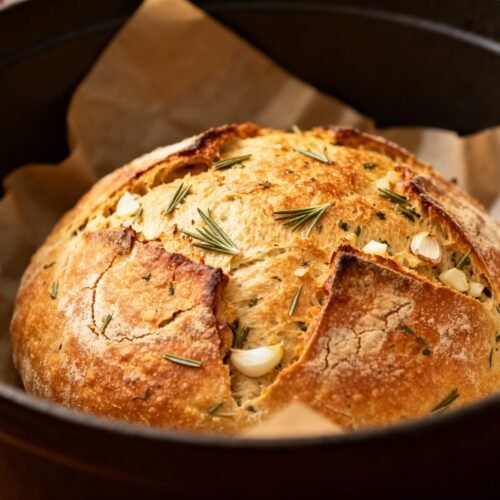
In a large bowl, whisk flour, salt, and instant yeast.
Stir in warm water and olive oil until a shaggy, sticky dough forms. No kneading.
Fold in rosemary and garlic with a spatula. The dough should feel sticky and loose.
Room temperature method: Cover the bowl tightly and let the dough rest 12–18 hours at room temp until doubled and bubbly on top.
Faster method: Give it 2–3 hours at warm room temp (75–80°F). Flavor develops less but still tasty.
Dust your counter with flour. Turn the dough out with a spatula.
Lightly flour your hands. Tuck edges toward the center to form a round ball. Handle it gently to keep gas bubbles.
Set the seam side down on a piece of parchment dusted with flour or cornmeal. Cover and rest 30–45 minutes.
Place a 4–6 quart Dutch oven with lid in your oven. Preheat to 450°F (232°C) for at least 30 minutes.
While it heats, sprinkle the dough top with a little flour and score a shallow X with a sharp knife or lame.
Carefully remove the hot pot. Lift the dough on parchment and lower it into the pot. Cover with lid.
Bake covered for 30 minutes, then uncover and bake 12–18 minutes more, until deep golden and crackly.
Check doneness: internal temp should read 205–210°F, and the loaf should sound hollow when tapped.
Cool on a rack at least 45–60 minutes before slicing to set the crumb.
Hydration matters: If dough looks dry, add 1–2 tablespoons water. If soupy, dust with a tablespoon of flour.
Don’t overwork it: Minimal handling preserves gas bubbles for an open crumb.
Heat equals crust: A fully preheated Dutch oven makes all the difference.
Cool before slicing: Cutting too soon compresses the crumb and makes it gummy.