Combine 350 g bread flour and 150 g whole wheat flour in a bowl.
Pour in 340 g water and mix until no dry flour remains. The dough may look shaggy.
Cover and rest for 30–45 minutes to hydrate the flour. This makes the dough easier to work.
Add 100 g active starter and mix with damp fingers until fully incorporated.
Sprinkle in 9 g salt with another 20–40 g water as needed. Pinch and fold until the salt dissolves and the dough feels cohesive.
Cover the bowl and rest for 30 minutes.
Perform a set of stretch-and-folds: grab one edge, stretch up, and fold over; rotate the bowl and repeat 4–6 times.
Repeat sets every 30 minutes for the first 2 hours (3–4 sets total). The dough should become smoother and more elastic.
Let the dough rise until it looks puffy by about 50%, jiggles when shaken, and shows bubbles along the sides. Adjust time for your room temp.
Lightly flour the counter and your hands. Turn out the dough.
Use a bench scraper to form a loose round, creating surface tension by tucking edges toward the center.
Rest uncovered for 20–30 minutes. The dough should relax but hold its shape.
Lightly flour the top of the dough, flip it, and shape into a tight round or oval. Build tension without tearing.
Dust a banneton (or towel-lined bowl) with flour. Place the dough seam-side up.
Cover and refrigerate for 8–16 hours for a slow, flavorful proof.
Place a Dutch oven in your oven and preheat to 475°F (246°C) for at least 30 minutes.
Cut a piece of parchment. Invert the cold dough onto it, seam-side down.
Score the top with a deep central slash about 1/2 inch deep to control the expansion.
Carefully lower the dough (on parchment) into the hot pot. Cover and bake for 20 minutes.
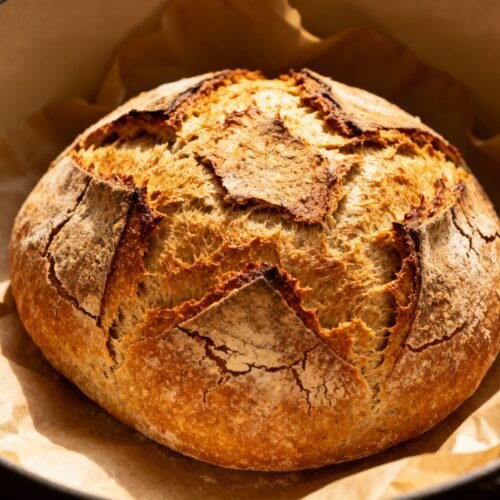
Reduce heat to 450°F (232°C), remove the lid, and bake another 20–25 minutes until deep golden-brown with a blistered crust.
Cool on a rack for at least 1–2 hours before slicing to set the crumb.
Color: deep golden-brown with darker edges
Sound: loaf feels light and sounds hollow when tapped
Internal temp: about 208–212°F (97–100°C)